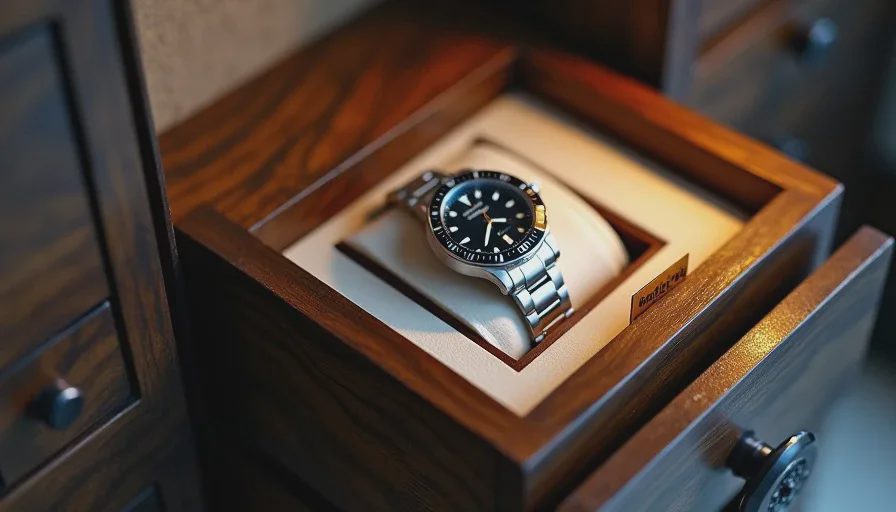
Let me tell you about the most expensive gift I ever gave.
It was three years ago. Eli and I had been married for four years, and we'd hit a rough patch — not the kind that makes you think about leaving, but the kind that makes you wonder how two people who love each other can feel so far apart.
He was working too much. I was working too much. We were passing each other in the hallway like ships that had forgotten they were supposed to dock.
And one night, after a fight that wasn't really about anything — the kind where you say things you don't mean and then don't know how to take them back — I bought him a watch.
Not a cheap watch. An expensive one. The kind with a leather strap and a face that caught the light and a price tag that made me wince.
I wrapped it. I gave it to him at dinner. I said "I'm sorry" without saying "I'm sorry" — because the gift was supposed to say it for me.
He opened it. He looked at it. He said "thank you, it's beautiful."
And he put it in the drawer. He never wore it.
Not because he didn't like watches. He did. Not because he didn't appreciate the gesture. He did. He knew I was trying.
But that watch was sitting in its box — and we were still fighting. We were still distant. We were still passing each other in the hallway.
Because the watch wasn't an apology.
The watch was a substitute for an apology.
And substitutes don't work. They don't fix anything. They just cover it up for a little while — and then the cover slips, and there's the thing you were trying to hide, still there, still aching, still waiting for you to actually say the words.
What the Diary Taught Me About Apology Gifts
When I went back through 400 entries, I found a pattern I didn't expect.
I have 47 entries where I described giving a gift "to make up for" something. A missed birthday. A fight. A period of distance. A time I wasn't there when I should have been.
And out of those 47 entries, only 6 of them worked.
The other 41? They landed like a thud. The recipient said thank you. They smiled. And then they went back to feeling whatever they'd been feeling before — because the gift hadn't addressed it.
An apology gift doesn't work because it doesn't do the one thing an apology needs to do: acknowledge the hurt.
Instead, it does something far more dangerous: it asks the recipient to pretend the hurt doesn't exist in exchange for a nice object.
And most people will do that. They'll smile. They'll say thank you. They'll put the object away — or worse, they'll use it — but the hurt will still be there, buried a little deeper, waiting for the next time it doesn't get acknowledged.
The Psychology of Why Apology Gifts Fail
This is the part where I put on my counseling hat, because I've seen this play out in therapy rooms more times than I can count.
When someone gives a gift instead of an apology, they're doing three things — usually without realizing it.
1. They're avoiding vulnerability.
A real apology is terrifying. It means admitting you were wrong. It means sitting in the discomfort of someone else's pain and saying "I caused that." It means not defending yourself, not explaining, not justifying — just witnessing.
A gift doesn't require any of that. You can buy a watch without ever saying "I was wrong." You can wrap a candle without ever saying "I hurt you." You can send flowers without ever saying "I'm sorry."
2. They're asking the recipient to be grateful instead of angry.
This is the most toxic part. When you give a gift in place of an apology, you're implicitly saying: "I gave you this. Now you can't be upset anymore. You owe me gratitude."
But gratitude and hurt don't live in the same space. The recipient is left trying to hold both — the nice thing you gave them, and the pain you caused — and it's almost impossible to do.
So they do what most people do when they're trapped between gratitude and hurt:
They shut down.
They say thank you. They pretend it's okay. And they store the hurt somewhere deeper, where it can't be seen — and where it grows.
3. They're telling the recipient that the relationship can be fixed with objects.
And that's a dangerous message. Because relationships can't be fixed with objects. They can only be fixed with words — words that acknowledge, words that take responsibility, words that open the door to repair.
When you give a gift instead of an apology, you're teaching the person you love that their pain is worth a price tag. And maybe that's not what you mean — but it's what they hear.
What a Real Apology Gift Looks Like
I want to be clear: I'm not saying you can never give a gift alongside an apology.
I am saying: the gift can't be the apology.
The apology has to come first. The words have to be spoken. The hurt has to be acknowledged. And then — if it feels right, if the person is ready to receive it — a gift can be a beautiful expression of repair.
Here's the difference.
A gift-as-apology:
You give it without saying the words
It arrives unexpectedly, often after a conflict
You expect gratitude
You feel "off the hook"
The recipient is left holding something nice and something painful at the same time
A gift-after-apology:
You say the words first: "I hurt you. I'm sorry. I'll do better."
You give the gift later, when the air is clearer
You expect nothing — not gratitude, not forgiveness, not even acceptance
You give it as an expression of commitment, not a payment for pain
The recipient receives something beautiful without carrying the weight of the unresolved hurt
The Gift I Should Have Given Eli Instead
I think about that watch sometimes. It's in a drawer in his workshop now. He doesn't wear it. But he's never gotten rid of it — because I gave it to him.
I should have done it differently.
I should have sat him down that night and said: "I'm sorry for what I said. I'm sorry for the way I've been distant. I'm sorry I've been making you feel like you're not a priority."
And then, later — days later, not minutes — I should have given him something. Not a watch. Something smaller. Something that didn't feel like a payment.
Maybe a note in his lunch bag. Maybe his favorite coffee, the kind I always forget to buy. Maybe just a quiet evening where I didn't look at my phone and he didn't look at his.
Something that said: I'm not trying to buy my way out of this. I'm trying to show you I'm here to stay.
That's the letter.
How to Know If You're Giving an Apology Gift
I want to give you a simple test. The next time you find yourself reaching for a gift to "fix" something, ask yourself these questions:
1. Have I actually said the words "I'm sorry"?
Not "I'm sorry you felt that way." Not "I'm sorry if I upset you." Not "I'm sorry but..." — just "I'm sorry." If you haven't said those words, the gift isn't an apology. It's a shield.
2. Am I giving this because I want to feel better, or because I want them to feel better?
This is the hardest question to answer honestly. Most apology gifts are for the giver. They're to get rid of the uncomfortable feeling of having done something wrong.
If the real purpose is to make yourself feel better, the gift will fail. Because the other person will sense it — and they'll feel used.
3. Am I okay with them not forgiving me?
If the answer is no, don't give the gift. Gifts that come with expectations of forgiveness are obligations, not offerings.
What to Do Instead

If you've given apology gifts in the past and they haven't worked — or if you're about to give one and you're suddenly feeling uneasy — here's what I recommend.
Step 1: Say the words.
Find them. Say them. No excuses. No justifications. No "but." Just the truth. It will be uncomfortable. It will be vulnerable. It will be the thing the other person has been waiting for.
Step 2: Wait.
Don't rush to "make it better." Give the other person space to react, to feel, to process. You've said your piece. Now let them have theirs. Even if they're angry. Even if they're sad. Even if they don't say anything.
Step 3: Listen.
Not to respond — to hear. Let them tell you what they need. Let them tell you what the hurt was. Let them tell you what would help them trust again.
Step 4: Give then — but only if it's right.
Maybe they'll want the gift. Maybe they'll need something else. Maybe they'll just need you to be different from now on. Whatever it is, give that. Not what you planned. What they actually need.
The Watch, Three Years Later
I found the watch last week. It was in the back of Eli's workshop drawer, next to some old sandpaper and a broken drill bit.
I picked it up. It still had the tag on it. He'd never even taken it off.
I took it to him and said: "I'm sorry I gave you this instead of an apology."
He looked at me. He put down the piece of wood he was sanding.
"I know," he said. "But I also know you were trying. And I've never needed the watch. I just needed you to say what you said tonight."
We went for a walk. We didn't talk much. But the air was clearer than it had been in three years.
That watch is still in the drawer. I don't think he'll ever wear it. But that's okay. Because now it's not a substitute for something he didn't get.
It's just a watch.
A Final Word
If you're reading this and you've given apology gifts before — and they didn't work — don't beat yourself up.
You were trying. You were doing the only thing you knew how to do. You were giving the language you had.
But now you have better language.
Now you know: the gift isn't the apology. The words are.
And when you put the words and the gift together — in that order — you're not buying your way out.
You're building your way back.
That's the only apology that works.


No notes yet — write the first one.