I've been thinking about this post for a long time.
Not because I didn't know what to write. Because I wanted to make sure I had it right. I wanted to make sure that everything I've learned — from the therapy room, from the diary, from the cards, from the stars, from twenty-two years of getting it wrong and sometimes getting it right — could be distilled into something simple enough to hold in your hands.
Something you could take with you into a store, or a flea market, or a late-night online search when you're panicking and you need an answer and you don't know where to turn.
I've written nineteen posts before this one. I've talked about Scorpio moons and Life Path 7s and The Hermit and apology gifts and flea market finds and love languages and the gift diary and the box Eli made me that I tried to pay for.
But I haven't written the post that puts it all together.
This is that post.
The Three Steps
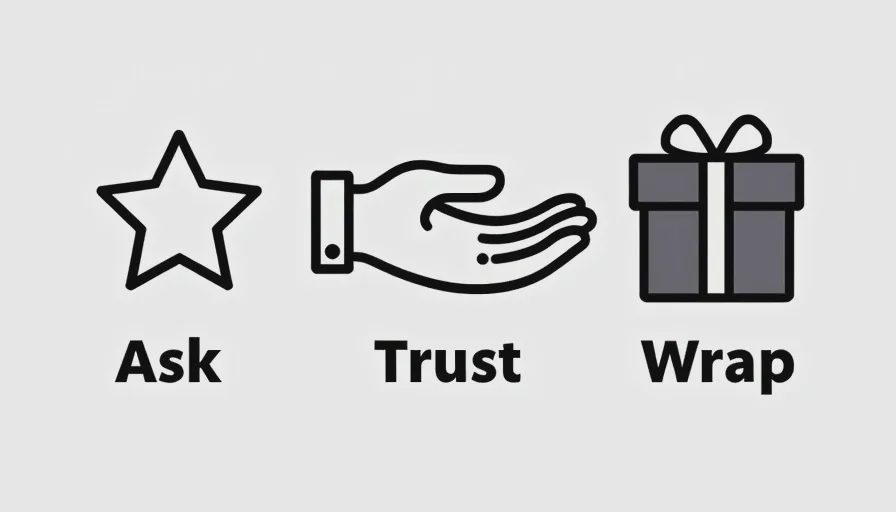
Here's the entire Iris & the Stars gift method. It's three steps. That's it.
Step 1: Ask the Stars.
Step 2: Trust Your Gut.
Step 3: Wrap It Well.
That's the whole thing. Everything else is commentary.
But let me tell you what each step actually means — because there's more to it than the words suggest.
Step 1: Ask the Stars
This is the part that looks like mysticism. It's not.
When I say "ask the stars," I mean: use a framework that helps you see the person more clearly than you can see them with your own eyes.
You can't see everything about someone. You're too close. You have your own blind spots. You have your own history with them, your own expectations, your own fears. Your own self gets in the way of seeing them clearly.
The stars — astrology, tarot, numerology — are tools for removing that self. They're not about predicting the future. They're about seeing the present more clearly.
When you ask the stars about someone, you're not asking "what will happen to them?" You're asking:
What are they actually like — not just what I see?
What do they need that they haven't said?
What's the part of them that I'm missing?
The stars don't give you answers. They give you questions. Better questions. Questions that help you see beyond your own assumptions.
How to do this step:
Look at their chart: What's their moon sign? Their rising sign? Their Venus placement? Each one tells you something different about how they experience love and receive care.
Pull a card: Use the three-card spread I gave you in Entry #002 — What I See, What They Need, What the Gift Should Say. It takes five minutes and it changes everything.
Calculate their numbers: What's their life path? Their soul-urge? Each one gives you a clue about what drives them at the deepest level.
You don't have to do all three. Just pick one. One tool. One question. One way of seeing them differently.
Then stop. That's enough.
Step 2: Trust Your Gut
This is the part that looks like intuition. It's not.
When I say "trust your gut," I mean: use your own knowing, which is built on something real — your history of paying attention.
Here's the thing about "trust your gut." It sounds like a feeling. It sounds like something you're born with or not. It sounds like a gift you either have or you don't.
That's not true.
My gut is trustworthy because I've spent twenty-two years training it. Every entry in the gift diary is data. Every successful gift is evidence. Every failure is information.
I trust my gut because I have four hundred pieces of evidence that it's often right.
And you have your own version of that. You've given gifts before. You've seen what lands and what doesn't. You've paid attention — maybe not in a diary, but in your memory. You know what your friend likes. You know what your partner needs. You know what your child's face looks like when they're genuinely delighted versus when they're being polite.
That's your data. That's your gut.
The gut isn't magic. It's memory. It's pattern recognition. It's the part of your brain that has been tracking all the small clues you didn't even know you were collecting.
How to do this step:
After you've asked the stars, sit with what you've learned. Don't rush to a decision.
Let your mind wander. Think about the person. Think about the last time they were truly happy. Think about the last time they were truly sad.
Ask yourself: What have I noticed about them that I haven't said out loud?
Then — and this is the important part — listen to the first thing that comes. Not the second thing. Not the thing you've talked yourself into. The first thing.
That's your gut. That's your data. That's your knowing.
Step 3: Wrap It Well
This is the part that looks like presentation. It's not.
When I say "wrap it well," I mean: complete the gesture. Don't stop at the object.
I've seen so many good gifts fail because they arrived without ceremony. Without context. Without the small rituals that turn an object into a letter.
Wrapping isn't about paper and ribbons. It's about presentation. It's about giving the gift the space and attention it deserves.
Think about it. A gift is a message. The object is the words. The wrapping is the delivery.
You can have the most beautiful words in the world, but if you deliver them carelessly, they won't land.
How to do this step:
Write a note. I'm not saying you have to write a novel. I'm saying: write something. Even one sentence. Even three words. Just something that tells the person you're not just handing them a thing — you're saying something to them.
If you can't write a note, do something that serves the same function. Place the gift somewhere they'll find it by surprise. Leave it on their pillow, their desk, their workbench. Make it feel like it arrived intentionally, not accidentally.
If you're wrapping, choose something that feels like them. Not fancy for the sake of fancy. But not thoughtless, either. The wrapping itself is the first message they receive. It sets the tone for everything that follows.
And when you hand it over, be present. Don't check your phone. Don't be distracted. Give them your full attention for the moment they open it. That's part of the gift too.
The Method in Action

Let me show you how this works with a real example.
Last month, I was shopping for a friend's birthday. She's a Libra sun with a Cancer moon — someone who loves beauty and harmony but also needs deep emotional safety. I pulled a card and got The Empress — which told me she needed to feel nurtured, cared for, and seen in her fullness.
That was Step 1: Ask the Stars.
Then I sat with it. I thought about her. I remembered how she'd been talking about her garden lately — how it was the only place she felt truly at peace. I remembered she'd mentioned wanting a better pair of pruning shears, but she'd said it in passing, like she didn't think anyone was listening.
That was Step 2: Trust Your Gut.
Then I went to the garden store. I found a pair of high-quality shears — the kind that last for years, that can be sharpened and repaired. I wrapped them in brown paper and tied them with twine. I included a note that said: "For the garden that holds you. I see you there."
That was Step 3: Wrap It Well.
She opened them. She read the note. She said "I can't believe you remembered." She's used them every day since.
That's the method.
It's not complicated. It's not mysterious. It's just three steps, done in order, with intention.
What the Method Is Not
I want to be clear about what this method is not.
It is not a formula. You can't follow it mechanically and expect magic. It's a frame, not a recipe. You have to fill it with your own attention, your own care, your own ability to see the person you're shopping for.
It is not a shortcut. It doesn't replace the work of knowing someone. It just gives you a way to organize what you already know and see what you're missing.
It is not a guarantee. You will still get it wrong sometimes. That's okay. That's how you learn.
What the Method Is
The method is a way of showing up.
A way of saying: "I'm paying attention. I'm using every tool I have to see you clearly. I'm trusting what I know about you. And I'm going to deliver this gift with care, because you deserve that."
That's it.
That's the entire gift method.
Ask the stars. Trust your gut. Wrap it well.
Three steps. Twenty-two years. Four hundred diary entries. Six years of therapy.
All of it, distilled into something you can carry with you the next time you're standing in a store, staring at shelves, wondering what to give someone who matters to you.
The Last Thing I Want You to Know
You already know how to do this.
You've been doing it all along.
Every gift you've ever given that worked — the one where they lit up, the one where they cried, the one where they said "how did you know?" — you did those three steps. You might not have named them. You might not have realized you were doing them.
But you did.
You asked a question. You trusted what you knew. You gave it with intention.
So this isn't about teaching you something new. It's about giving you a name for what you already do.
Ask the stars. Trust your gut. Wrap it well.
That's the letter.
Now go wrap it.


No notes yet — write the first one.