
The diary lives in the top drawer of my nightstand. It's not beautiful — the binding is cracked, the pages are yellowed, and the cover is stained with something I can't identify (coffee, maybe, or the tea I spilled in my twenties trying to be sophisticated).
I've moved it eight times. Four apartments, two cities, a graduate school dorm, and finally this house in Asheville where Eli and Willow and I are still figuring out where everything goes.
It's not a journal in the "Dear Diary" sense. There are no entries about crushes or fights or the weather. There's only one thing in it, written over and over again for twenty-two years:
What I gave. Who I gave it to. Why I chose it. How they reacted. How I felt.
That's it. Four hundred and something entries. I stopped counting at four hundred.
I started it when I was twelve, after the navy blue tie. I don't remember deciding to start a diary. I just remember thinking: I never want to miss like that again. So I bought a spiral notebook from the drugstore and wrote:
Entry #1. Father's Day. Navy blue silk tie, striped. I thought it would make him look important. He said thank you and put it back in the box. I don't think he liked it. I feel like I failed.
That's the first line of my entire gift-giving history. I wrote it in purple gel pen, and I can still see how hard I pressed — the letters are imprinted on the next four pages.
Twenty-two years later, I'm still writing. And I finally understand what I was doing all along.
What the Diary Taught Me — The Data
Here's what I found when I finally went back and read the whole thing.
Not in a sentimental way. In a research way. I sat with a cup of tea and a spreadsheet and asked myself: what patterns are hiding in here?
Here's what showed up.
1. The gifts I agonized over most were the ones that landed worst.
There's a direct correlation between the number of times I wrote "I don't know what to get them" and the number of times I later wrote "they seemed confused."
The entries where I wrote "I found this and just knew" — those are the ones that got reactions like crying, hugging, late-night texts, and the kind of silence that means someone is too moved to speak.
I spent so many years believing that gifts were about effort. That the more I worried, the more it meant. But the diary told me something different: the best gifts come from attention, not anxiety.
2. People remember who gave them something that fit — not what it cost.
I have 47 entries about gifts I spent over $100 on. I have 63 entries about gifts I spent under $20 on.
Want to guess which ones got the stronger reactions?
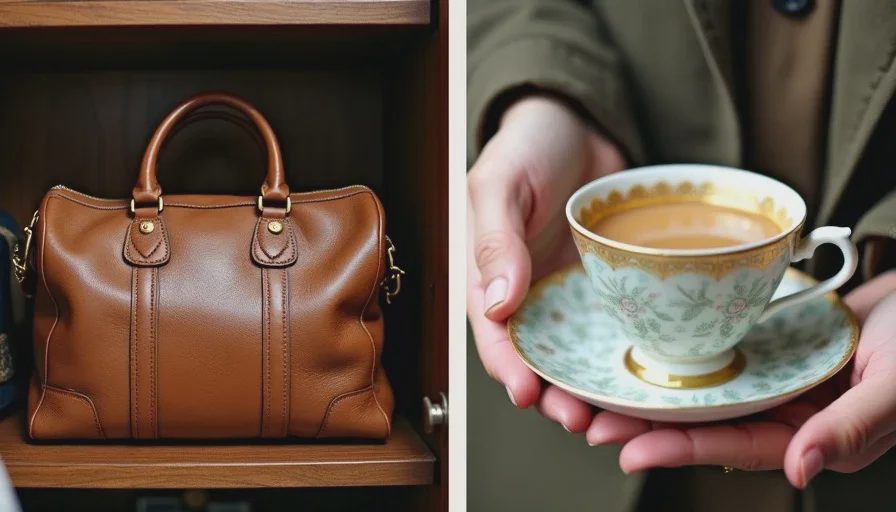
Not the expensive ones. The accurate ones. A $12 vintage teacup from a flea market got a response I wrote down as "she cried for ten minutes." A $180 leather bag got "she said thank you and put it in the closet."
The diary doesn't lie. Accuracy beats cost every single time.
3. The gifts I gave out of obligation are the ones I barely remember.
Christmas presents for distant relatives. Secret Santa swaps at work. Wedding gifts for people I barely knew.
I have entries for all of them, but the descriptions are thin. I didn't know the person. I didn't care enough to try. And the gifts showed it — generic candles, generic wine, generic scarves.
Those entries are the ones I skip when I read the diary now. Not because they're boring to me, but because they're boring in me. They don't matter. I wasn't present when I chose them.
4. The gifts that got the strongest reactions were the ones that said something I was too afraid to say out loud.
Here's a pattern I didn't expect.
When I gave my mother a framed photograph of my grandmother — the one who'd been gone for fifteen years — I didn't say "I know you miss her and I do too." I just gave her the frame.
She cried for an hour.
When I gave Eli a watch in our first year of dating, I didn't say "I think you're the one I want to spend my time with." I just gave him a watch that needed winding.
He wore it for six years until the strap fell apart.
The diary taught me that gifts are my language for the things I can't say. Every entry is proof that I've been writing letters my whole life, just not with words.
The Big Insight: We Give for Three Reasons
After going through 400 entries, I finally distilled it down to three reasons why we give.
Not "love," not "obligation," not "it's Christmas."
Here's what I found.
Reason 1: We Give to Be Seen
We want the person we're giving to to look at us and say "you get me." We want the gift to reflect something about ourselves — our taste, our care, our ability to notice.
The entries where I wrote "I wanted them to know I'd been paying attention" are the ones that hit hardest.
But here's the thing. When we give to be seen, we're also taking a risk. Because what if they don't see? What if they open it and look confused, and we feel invisible all over again?
That's the vulnerability of giving. It's not about the object. It's about saying "I'm here. I see you. Please see me back."
Reason 2: We Give to Protect
I started the diary after a giving failure. I wanted to protect myself from ever missing again. Every entry after that was, in some way, an attempt to keep myself safe from that feeling of rejection.
Later, I started giving to protect other people. I gave my father books about relaxation when he was working too hard. I gave my friends "self-care" gifts when they were going through difficult times. I gave Eli a warm coat when he was spending winter nights in the woodshop.
I was saying: I can't fix what's hurting you, but I can wrap something around it.
And the diary shows: those gifts — the protective ones — are the ones that get held onto the longest. Not because they're sentimental. Because they feel like armor.
Reason 3: We Give to Connect
The entries where I wrote "I don't know why I picked this, it just felt right" — those are the connection gifts. The ones I can't explain logically. The ones where something clicked and I thought "this is for them" and I couldn't have told you why if you'd asked.
Those are the magic ones. And I don't mean magic in a mystical sense. I mean magic in a connection sense — the part of the brain that knows someone better than the mouth can speak.
I have 72 entries where I wrote "I just knew." And 70 of them got reactions like "how did you know?" "this is perfect" or "this made me feel so seen."
The connection gifts are the ones that bypass logic entirely.
What I Wish I'd Known at Twelve
If I could go back to that twelve-year-old girl with the purple gel pen and the drugstore notebook, I'd tell her three things.
He didn't reject the tie. He was protecting it because you gave it to him. That's love, not failure.
The diary is not a scorecard. You're not keeping track of wins and losses. You're learning a language — the language of how people receive love. It takes time. It takes getting it wrong.
You're going to give hundreds of gifts. Some will land. Some won't. But the diary will be the map you follow back to what actually works. You're building it right now. Don't stop.
Why I'm Showing You This
I don't share the diary lightly. It's private. It's my data, my failures, my small triumphs, my messy history of trying to love people and sometimes getting it wrong.
But I'm sharing it because I want you to know:
I'm not a guru. I'm not a psychic. I'm not someone who was born knowing how to give perfect gifts.
I'm someone who got it wrong so many times that I started keeping track — and after twenty-two years, I finally have a system that works.
Astrology helps. Tarot helps. Numerology helps. But the real backbone of everything I do is that battered notebook with the coffee-stained cover.
400 entries. 22 years. And the only thing that matters, in all of it, is this:
People want to be seen, protected, and connected to.
And gifts — when we do them right — are the loudest whisper of all three.
One Last Entry
I wrote this one yesterday. I'll write it here, raw and unpolished, the way it lives in the diary.
Entry #403. Willow. Six years old. I gave her an index card with "You can draw your own tarot card every morning" written on it, plus a set of colored pencils and a stack of blank cards I cut myself.
I chose it because she asked me last week "Mama, what does it mean if I pull the Star?" and I realized she wants to be part of this world I live in. She wants to understand the things I understand. She's not old enough for a real deck — but she's old enough for the question. She's old enough to say "I want to know what you know."
She drew her first card this morning and held it up. "Mama, this one is a hug."
She made it with pink and yellow and a star that looked more like a sun. But she was right. The Six of Cups. The card of childhood. The card of returning to something pure.
I wrote down her reaction: "She smiled like she'd made the most important thing in the world."
Maybe she had.

No notes yet — write the first one.