
In astrology, capricorn rising means Capricorn was on the eastern horizon at the moment and place of your birth. Astrologers associate this rising sign with a measured first impression, a practical approach to unfamiliar situations, and a preference for building trust over time. It is a symbolic interpretation, not a scientific assessment of personality. To find out whether it applies to you, you need your birth date, location, and a reasonably accurate birth time.
What the rising sign represents
A rising sign, also called the ascendant, is one of the main reference points in a birth chart. Astrologers commonly use it to describe how someone approaches new situations and how others may initially perceive them. Your sun sign is a separate placement, determined by the sun's position at birth; your moon sign describes another part of the chart.
A person can have capricorn rising with a sun or moon in any sign. That distinction matters: someone with a lively, expressive sun sign might still come across as reserved at first, according to this interpretive framework. The rising sign is not a substitute for the rest of the chart, and it should not be treated as a fixed description of someone's behavior.
Capricorn is an earth sign traditionally associated with Saturn. In astrological readings, earth signs are often connected with practical concerns, while Saturn is linked to structure, limits, responsibility, and time. Put those pieces together and the usual reading emphasizes planning, reliability, and an interest in what will hold up over the long run.

How to check for capricorn rising
Start with your birth certificate or another reliable record that states your time of birth. Gather the date and birthplace too, then enter all three into a birth-chart calculator. Look for the label “ascendant,” sometimes abbreviated “ASC.” The sign shown there is your rising sign.
Use the recorded local birth time rather than converting it to another time zone yourself, unless the calculator specifically asks you to do so. Enter the correct city so the tool can account for the location and time-zone rules. If a calculator asks about daylight saving time, check the instructions rather than assuming the setting.
Birth time matters because the ascendant changes throughout the day. There is no single reliable number of minutes you can round without checking: the effect depends on the chart and how close the ascendant is to a sign boundary. If your record says only “morning,” a calculator's default noon setting is a placeholder, not evidence that you have capricorn rising.
When the time is uncertain, run charts at the earliest and latest plausible times. If the ascendant changes sign within that window, note both possibilities rather than picking the one that sounds more like you. Even if the sign stays the same, the degree and house placements can still shift. A birth record is a better starting point than trying to infer an exact time from a personality description.
How astrologers interpret this placement
A common interpretation of capricorn rising is that a person assesses the situation before stepping in. In a new group, that might look like listening first, asking what the expectations are, or preferring a clear role. Some astrologers also associate the placement with a serious or composed outward manner.
Those descriptions are possibilities within astrology, not a checklist. A quiet first impression does not prove someone has this placement, and a sociable person can have it too. Culture, circumstances, habits, and individual experience all affect how people act.
The potential strength in the traditional reading is follow-through: setting a goal, breaking it into workable stages, and taking obligations seriously. The potential difficulty is carrying too much responsibility or feeling that every step must be productive. As a reflection prompt, consider where structure helps you and where a more flexible plan would serve you better. No birth chart can establish whether a person is dependable or predict how a particular relationship will go.
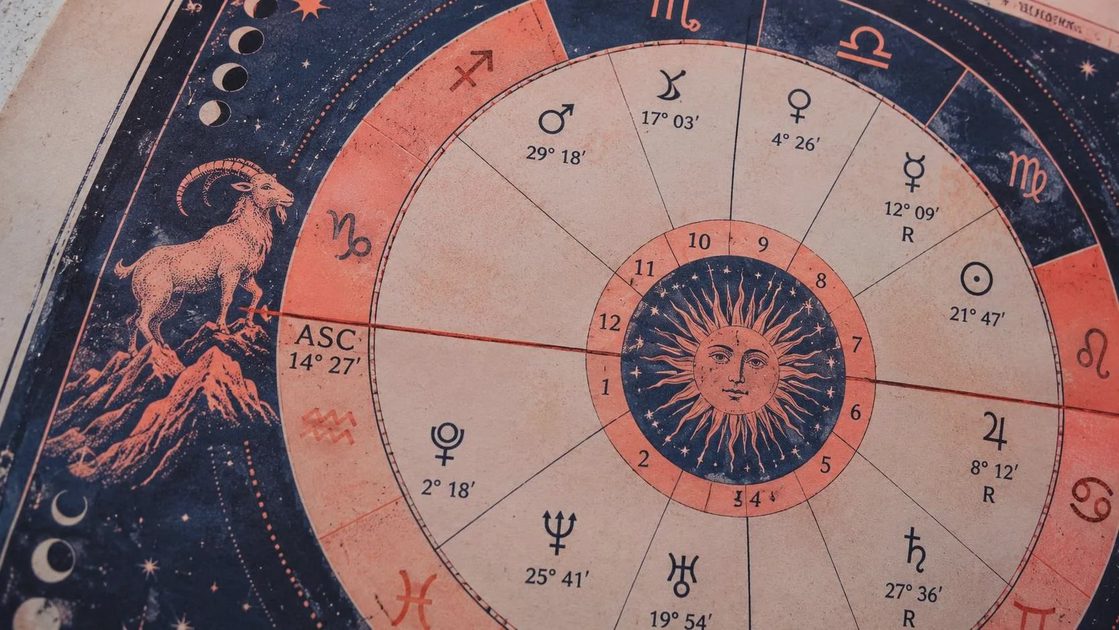
Saturn, houses, and the rest of the chart
Because Saturn traditionally rules Capricorn, astrologers often look at Saturn's sign, house, and aspects when interpreting capricorn rising. An aspect is an angular relationship between chart placements. In this approach, Saturn's position adds context rather than replacing the basic rising-sign interpretation.
The ascendant also serves as a starting point for chart houses, which astrologers use to organize areas of life. The exact house boundaries depend on the house system selected in the calculator. With whole-sign houses, Capricorn is the entire first house for someone with this ascendant. Other systems can place house boundaries differently, so two charts can show the same rising sign but display some planets in different houses.
If two calculators disagree, compare the inputs before trying to interpret the result. Check the birth time, city, daylight-saving setting, and whether each tool uses tropical or sidereal zodiac positions. Those zodiac systems measure signs differently and can produce different sign labels for the same birth data. A difference in house system alone generally changes house divisions, not the ascendant's zodiac position.
Use the reading without treating it as a diagnosis
The useful next step is to read the full chart with its assumptions visible: which zodiac system was used, how certain the birth time is, and where Saturn appears. That gives an astrologer more to work with than a stand-alone description. It also gives you a way to compare interpretations without treating a broad personality sketch as a proven fact.
Astrology is not a reliable basis for medical, financial, or other consequential decisions. Use the reading, if you enjoy it, as a way to frame questions rather than settle them. What time and place does your birth record actually give, and does your ascendant stay in the same sign across the plausible time window?





No notes yet — write the first one.