
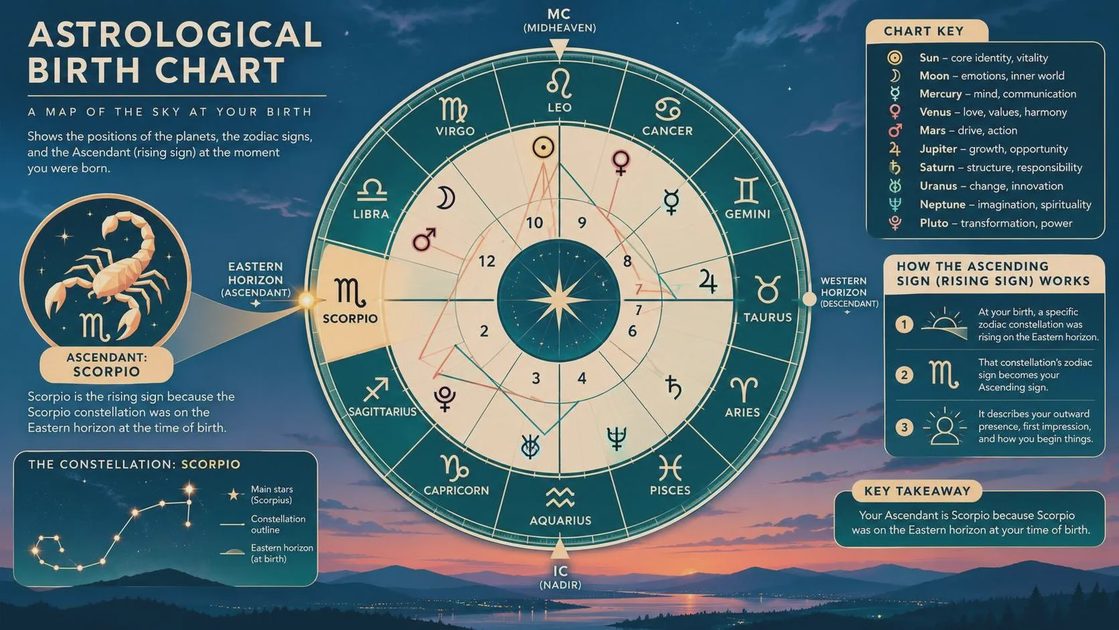
In astrology, scorpio rising means Scorpio was on the eastern horizon at the time and place of your birth. Astrologers associate this ascendant with a private, observant approach to new situations and an intense first impression. It is one part of a birth chart, not a diagnosis or a reliable prediction of personality. Your exact birth time matters: a small error can change the rising sign when the ascendant is near a sign boundary.
What a rising sign represents
The rising sign, also called the ascendant, is calculated from your birth date, time, and location. Unlike your sun sign, it changes relatively quickly over the course of a day. Two people born on the same date in the same city can have different rising signs if they were born at different times.
Astrologers commonly use the ascendant to describe how someone approaches unfamiliar situations and how they may initially come across to others. They treat the sun sign as a different part of the chart, often associated with identity, and the moon sign as another, associated with emotional patterns. Interpretations vary between astrological traditions and practitioners.
That distinction is useful if a description of Scorpio rising sounds nothing like your sun-sign horoscope. The two placements answer different questions within astrology; one does not cancel the other. Also, a rising sign is not the same thing as having the sun, moon, or another planet in Scorpio.
Traits commonly associated with Scorpio rising
Astrological descriptions often portray this placement as watchful, self-contained, and selective about trust. A person with Scorpio rising might be described as someone who takes time to assess a room before joining the conversation. The same interpretation can frame that caution as a strength in situations that call for discretion or careful observation.
The less flattering version of the same story is that reserve can be mistaken for suspicion, or that a preference for privacy can make it harder for others to know what someone needs. Those are interpretive themes, not traits you can establish from a birth chart. People with the same ascendant can have very different temperaments and life experiences.
You may also see claims about a piercing gaze, a particular body type, or an ability to detect lies. Treat those as astrological stereotypes, not dependable ways to identify someone. There is no physical checklist that establishes an ascendant, and astrology is not a scientifically validated method for assessing personality.
How to check your birth chart
Start with three details: your birth date, your recorded local birth time, and your birthplace. Enter them into a birth-chart calculator, then look for the label “Ascendant,” “ASC,” or “Rising.” The result should show both a sign and a degree. For example, Scorpio at 2 degrees and Scorpio at 28 degrees are both Scorpio ascendants, but the latter is closer to the next sign boundary.
Use a birth certificate or another reliable record if one is available. A remembered time such as “around breakfast” may be too broad to settle the question. If the record gives a range, run the chart at both ends of that range. If the sign changes, the available information does not establish one rising sign with confidence.
Check that the calculator has the correct birthplace and handles the local time zone and any daylight saving rules for that date. Enter the local time as recorded unless the tool specifically asks for a different format. Converting it yourself and then letting the calculator convert it again can produce an incorrect chart.
If your time is unknown, you can still explore some placements, but do not treat a default noon chart as evidence of Scorpio rising. An astrologer may offer birth-time rectification, an attempt to estimate a time from life events, but that process cannot verify an undocumented birth time.
Mars, Pluto, and the rest of the chart
In traditional astrology, Mars rules Scorpio. Modern Western astrology often also associates Scorpio with Pluto. When interpreting Scorpio rising, an astrologer may therefore look at Mars, or at both Mars and Pluto, to add context. Different practitioners give those planets different weight.
The sign and house of Mars can change the interpretation an astrologer gives. For instance, Mars in an air sign may be read differently from Mars in an earth sign. Rather than assuming either placement proves anything about behavior, use the comparison to understand how the astrological system builds a more detailed reading.
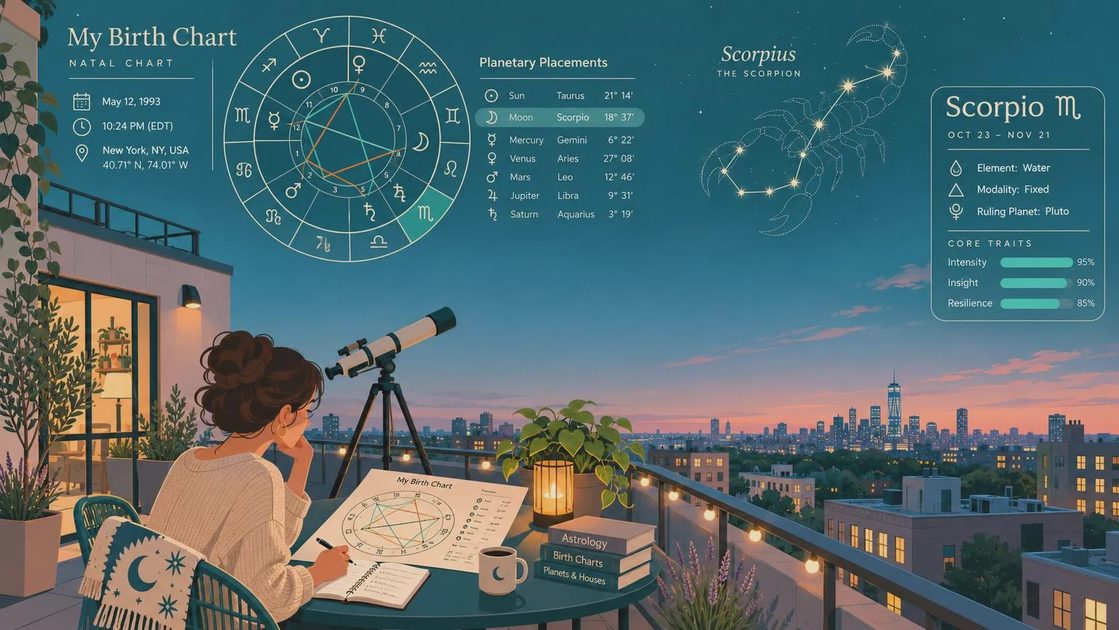
Planets close to the ascendant are another consideration. Astrologers may interpret a planet near that point as modifying the usual description of the rising sign. House systems also differ: some divide houses from the ascendant by degree, while whole-sign houses assign the entire rising sign to the first house. That can change where a planet appears by house without changing the planet’s zodiac sign.
If two chart websites disagree, compare their settings before assuming one has made a calculation error. Check the birth data, the zodiac setting, and the house system. Tropical and sidereal zodiacs use different reference systems and can produce different sign placements from the same birth details. A site should say which system it uses.
What this placement does and does not tell you
A Scorpio rising reading can be a prompt for reflection: Do you prefer to observe before committing? How do you decide when to share information? Those questions may be useful whether or not the placement resonates. They are not a substitute for evidence about your relationships, health, work, or finances.
Avoid making a major decision solely because a reading says a particular outcome is destined. If a description feels off, you do not need to force a match. Check the birth details and chart settings first, then consider whether the interpretation is meaningful to you at all.
What birth-time source or chart setting helped you confirm your ascendant?




No notes yet — write the first one.