
A relationship astrology chart compares two people's birth charts or combines their birth information into a single chart. To get started, gather each person's birth date, exact birth time, and birthplace, then choose a synastry chart if you want to see how the two charts interact. A composite chart offers a different symbolic view of the relationship itself. Neither can reliably predict compatibility or whether a relationship will last; astrology is best treated as a prompt for reflection, not evidence about someone's character or behavior.
Start with the right chart and accurate birth details
The most useful relationship astrology chart depends on the question you're asking. Synastry puts two individual birth charts side by side and compares their placements. It is the practical starting point if you want to explore how astrologers interpret differences between two people. For example, an astrologer might compare one person's Venus with the other person's Mars when discussing attraction and affection.
A composite chart, by contrast, typically uses the midpoints between corresponding placements in the two birth charts to create one combined chart. Astrologers read that chart as a symbolic description of the relationship's shared patterns. It is not an average personality test, and its placements are not things either person necessarily has in their own birth chart.
For either approach, collect the date, local birth time, and town or city of birth for each person. A birth certificate or a family record may help, but do not assume a remembered time is exact. The time and place affect the rising sign and house placements, and an uncertain time can also affect other calculations, including the Moon's sign if it was close to changing signs.
If one time is unknown, you can still look at some planetary sign placements and aspects, but flag anything that could change over the possible birth-time window. Don't quietly enter noon and read the resulting rising sign or houses as fact. That is the chart-reading equivalent of putting an unconfirmed delivery date on the schedule and treating it as a commitment.
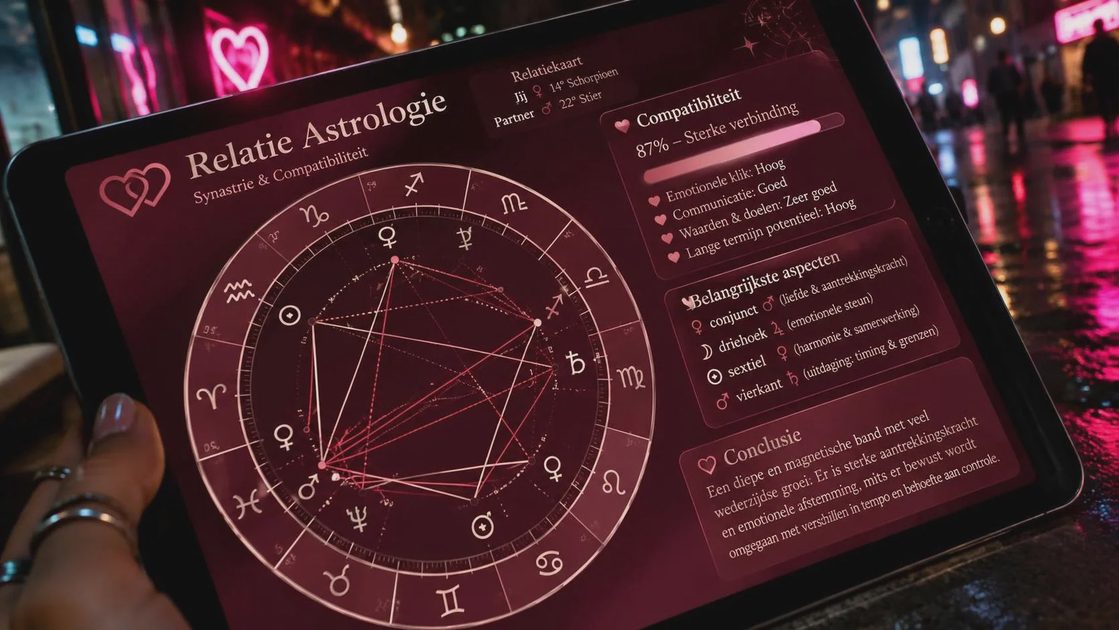
Read a relationship astrology chart in a useful order
Start with the Sun, Moon, Venus, and Mars in each individual chart. In astrology, the Sun is commonly associated with identity, the Moon with emotional needs, Venus with affection and values, and Mars with drive and action. These are interpretive conventions, not measured personality traits.
Next, look at aspects: the angular relationships between placements. A conjunction places two points close together; a square is roughly 90 degrees apart; a trine is roughly 120 degrees apart; and an opposition is roughly 180 degrees apart. Chart calculators usually allow a margin around the exact angle, called an orb. That margin can vary by calculator or astrologer, so two reports may not highlight exactly the same connections.
Read a few prominent aspects rather than treating every line on the wheel as equally important. For instance, a Moon-Venus aspect might prompt a conversation about how each person likes to give and receive care. A Mars-Saturn aspect might prompt a discussion about pacing, frustration, or boundaries. Neither aspect proves that a couple will be affectionate or experience conflict.
Finally, consider houses only when the relevant birth times are reasonably reliable. In synastry, a house overlay describes where one person's planet falls in the other person's chart. Astrologers may interpret a planet in the fourth house in relation to home or family themes, for example. House systems differ, so check which system the chart uses before comparing reports.
Synastry and composite charts answer different questions
A relationship astrology chart can become confusing when a report blends the two methods without labeling them. In synastry, a statement such as "your Venus is square their Mars" compares placements belonging to two different people. In a composite reading, "Venus square Mars" describes an aspect within the combined chart. Those are not interchangeable claims.
Use synastry first to identify a small number of themes for discussion. Then, if you are curious, look at a composite chart as a separate interpretive layer. Write down which chart a claim came from, the placements involved, and whether either birth time is uncertain. This simple record makes it easier to spot when a dramatic summary rests on an unreliable input.

Do not worry if the charts appear to disagree. Astrology does not have a standardized method for weighing every placement, aspect, and house, and interpretations vary. A report that declares one chart "good" and another "bad" is smoothing over that uncertainty rather than resolving it.
Turn interpretations into specific conversations
The useful output of a relationship astrology chart is a better question, not a compatibility score. If a reading raises the subject of emotional support, ask: "When you're stressed, do you want advice, company, or time alone?" If it raises conflict, ask: "How long should we pause before coming back to a disagreement?" The answers matter more than the symbols that prompted them.
For a couple managing a renovation, the same approach can make an abstract conversation concrete. Discuss who can approve a change order, what spending amount requires both people's agreement, and who will call the electrician when the inspection date moves. Put the answers in writing alongside the project schedule. If it's not on the schedule, it's not happening.
A chart should never override observed behavior. Reliability, respect, consent, and the ability to repair a disagreement are things people demonstrate over time. If a partner is controlling or unsafe, a favorable interpretation is not a reason to dismiss that behavior or stay in a harmful situation.
Before sharing birth details with an online calculator or another person, check what information is required and whether you are comfortable with its privacy practices. Get the other person's permission before entering or circulating their details. Then treat the reading as a conversation starter you can disagree with, not a decision someone else has made for you.
What question would you want a chart reading to help you discuss with your partner?




No notes yet — write the first one.