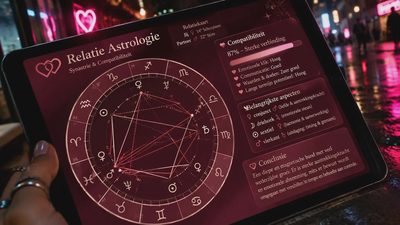
A synastry chart compares two people's birth charts to show where their planets form relationships called aspects. Astrologers use those connections to discuss attraction, communication, friction, and other relationship themes. It is an interpretive tool, not a reliable test of compatibility or a prediction that a relationship will succeed. Start with both birth dates, locations, and times; then look at a handful of close connections rather than trying to decode every line at once.
Think of it as a comparison of two sets of placements, not a single chart for the relationship itself. That distinction matters when you generate one: a composite chart is a different astrological technique, and its results should not be read as though they were two birth charts overlaid.
What you need before making a synastry chart
For each person, collect the birth date, exact birth time, and birth city or town. A birth certificate may give a more dependable time than a family recollection, though the level of detail on certificates varies. Enter the location as the place of birth, not where the person lives now. Chart software uses that location and time to calculate the rising sign and house positions.
If one person's time is unknown, enter the date and location and use an unknown-time setting if the calculator offers one. Do not quietly enter noon and treat the resulting houses as fact. An assumed time can change the rising sign and house cusps, and it may affect the Moon's sign if the Moon changed signs that day. Planetary degrees can shift during the day too, so aspects close to a chosen cutoff deserve extra caution.
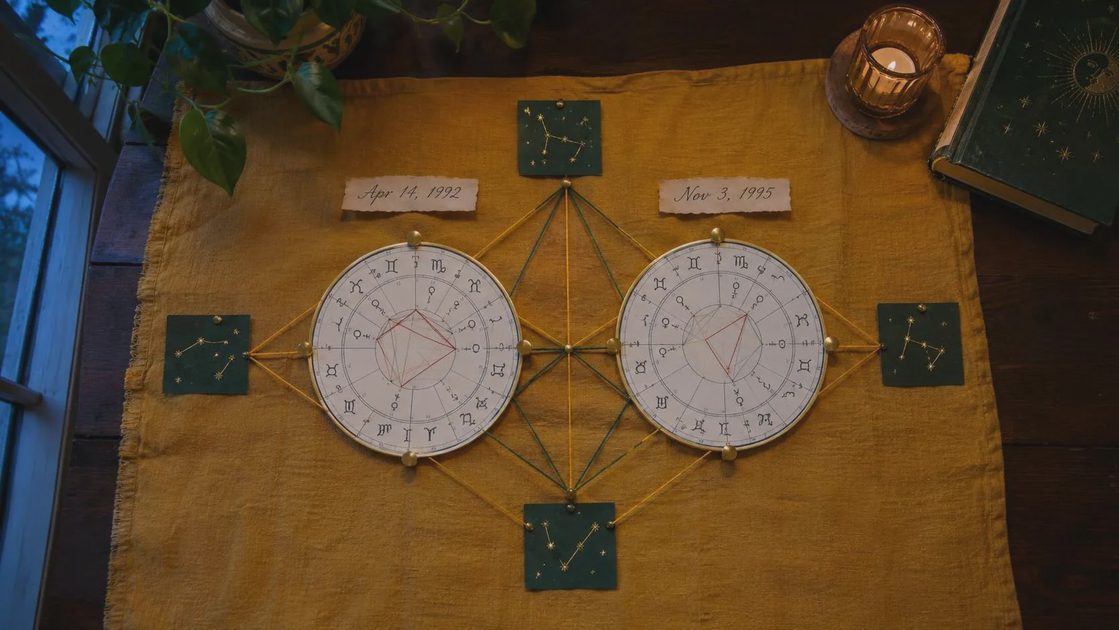
Before reading the results, confirm which birth details belong to the inner wheel and which belong to the outer wheel. Calculators label these differently. A simple swap can reverse statements about whose planets fall into whose houses.
Read the planets and aspects first
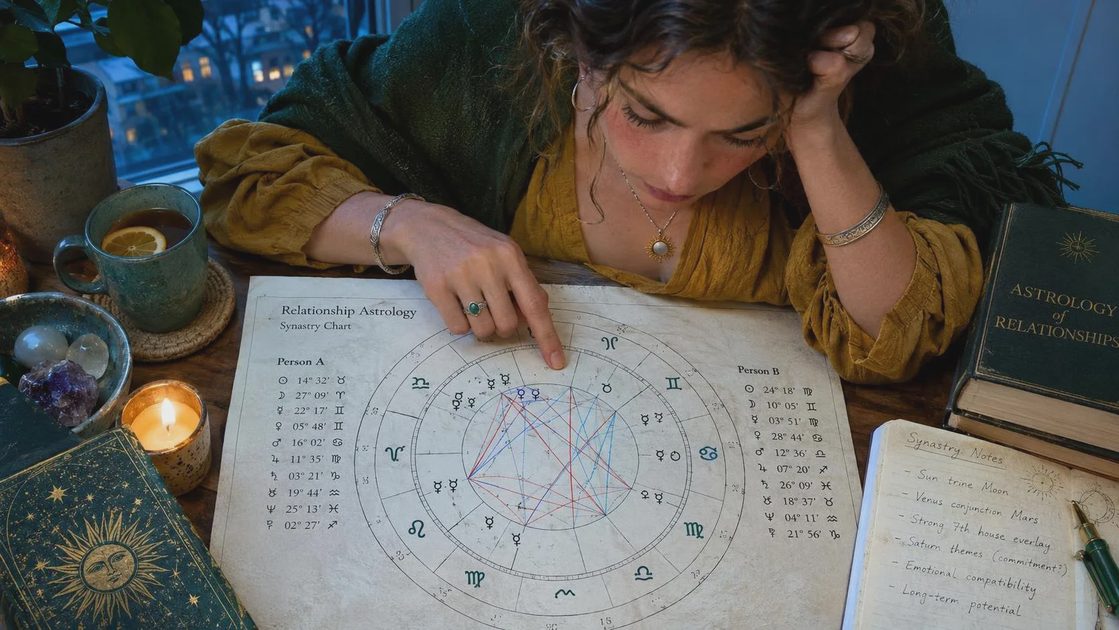
In a synastry chart, start with the Sun, Moon, Mercury, Venus, and Mars. In astrology, the Sun is associated with identity, the Moon with emotional needs, Mercury with communication, Venus with affection and relating, and Mars with drive and conflict. These are interpretive categories, not measurements of personality.
An aspect is an angular relationship between two planets. A conjunction means they are close together in the zodiac. A trine is roughly 120 degrees apart, a square roughly 90 degrees, and an opposition roughly 180 degrees. A sextile is roughly 60 degrees. The exact separation usually does not have to match the target angle: the permitted difference is called an orb.
Astrologers differ on how wide an orb to use. For a manageable first pass, look at aspects within about 3 degrees of exact, then consider wider ones if the chart has few close connections. That is a reading choice, not a scientific threshold. The chart's settings may also change which aspects appear, so check the orb filter before comparing two websites' results.
Suppose one person's Mercury is 12 degrees into a sign and the other person's Venus is 14 degrees into the same sign. That is a conjunction with a 2-degree orb. An astrologer might read it as a link between communication and affection. It does not establish that either person listens well, avoids conflict, or shares the same expectations.
What the houses add
A synastry chart can also show one person's planets falling into the other person's houses. Houses are sections of the birth chart that astrologers associate with areas of life. For example, a planet in someone's seventh house is commonly interpreted through partnership themes; a planet in the fourth may be read through home and family themes.
Keep the direction straight: your Venus in another person's seventh house is not the same overlay as their Venus in your seventh house. Both can appear, but each is a separate placement. Read the wheel's labels or the accompanying table before drawing conclusions.
House overlays depend on a reliable birth time for the person whose houses are being used. If that time is missing or approximate, leave the overlay out of your main interpretation. House systems can also produce different boundaries, so note which system a calculator uses when comparing results.
Put difficult-looking connections in context
A square or opposition in a synastry chart is not a warning that the relationship is doomed. Astrologers often associate these aspects with tension or differences that need attention; they may read trines and sextiles as easier-flowing connections. Those labels describe an astrological tradition, not a score for how two people will behave.
Saturn, Uranus, Neptune, and Pluto appear in comparisons too. Astrologers may connect Saturn with responsibility or limits, Uranus with change, Neptune with ideals or uncertainty, and Pluto with intensity or power. Avoid taking a single description as a diagnosis. People born close together can share some slow-moving planetary placements, so a broad generational match is not necessarily a distinctive feature of one relationship.
If a chart description raises a useful question, make it concrete. Instead of deciding that a Mercury aspect means poor communication, ask how each person prefers to resolve a disagreement and whether both can pause a conversation without feeling dismissed. The answer comes from the people involved, not the wheel.
Use the reading without handing it the decision
A synastry chart can be a conversation starter if both people enjoy astrology. Agree on what you want from the exercise, share only birth information each person is comfortable sharing, and check the privacy terms before entering another person's details into a website. You do not need someone else's exact birth time to have a useful conversation about boundaries or expectations.
For decisions about trust, commitment, or safety, give more weight to observable behavior. Repeated dishonesty, pressure, or disregard for boundaries is not canceled out by a supposedly harmonious aspect. Equally, an awkward-looking chart does not prove that a considerate relationship is a bad match.
If you're comparing readings, what part of the process was hardest to pin down: the birth time, the aspect settings, or whose house a planet falls into?



No notes yet — write the first one.