
Zodiac sign interpretation is more useful when you treat it as a framework for noticing patterns rather than a fixed script for your life. A birth chart can describe how someone approaches decisions, handles pressure, communicates, and organizes relationships. It cannot schedule your week, replace professional advice, or prove that two people are destined to agree. The practical goal is to turn symbolic information into questions you can actually test in daily life.
Start with the three main placements
The sun sign is the easiest place to begin. It is based on the Sun's position when you were born and is commonly associated with identity, purpose, and the way you want to express yourself. Someone with a Taurus Sun, for example, might value consistency, while a Gemini Sun may be energized by variety and conversation. Those are starting themes, not complete personality reports.
The moon sign is often used to discuss emotional habits, comfort, and private reactions. A person who appears calm in public may have a more restless or sensitive inner process shown by the moon placement. The rising sign, also called the ascendant, describes the sign appearing on the eastern horizon at birth. Readers often connect it with first impressions, physical approach, and the style used to enter unfamiliar situations.
Good zodiac sign interpretation compares all three instead of treating the sun sign as the entire person. A Capricorn Sun with a Pisces Moon and Libra rising will not read like a simple Capricorn stereotype. The contrast between placements is where the analysis becomes more specific.
Why the birth time matters
A chart requires a birth date, location, and usually an accurate birth time. The date identifies planetary positions, but the time helps calculate the rising sign and houses. A difference of even 15 or 20 minutes can sometimes affect the ascendant, especially when a sign is close to changing. If the time is unknown, a reader can still discuss the sun and many planetary placements, but should clearly label the chart as incomplete.
Location matters because the horizon and house structure change across the country and around the world. A chart calculated for Denver will not necessarily match one calculated for Miami at the same clock time. Daylight saving settings and time zones also create avoidable errors in online chart tools. Enter the birth information carefully, then save the source details alongside the chart so you can reproduce the calculation later.
This is one reason responsible zodiac sign interpretation avoids confident claims based on an uncertain birth time. If a result depends on the ascendant, record the uncertainty instead of presenting one answer as guaranteed.
Read planets by role, not as isolated labels
The planets add different functions to the chart. Mercury is commonly associated with communication and thinking. Venus is linked with affection, attraction, values, and preferences. Mars describes drive, assertion, and how a person pursues an objective. Jupiter is often read through growth and opportunity, while Saturn points toward limits, duties, and lessons learned through repetition.
The outer planets tend to describe broader generational patterns when they appear in the same sign for many people. That does not make them irrelevant, but their house placement and relationship to personal planets usually provide more individual detail. For instance, Mars in Virgo may suggest an action style built around preparation and useful problem-solving. Mars in Sagittarius could point toward direct movement, risk, or a need for open space. Neither placement guarantees behavior in every situation.
A useful reading asks three questions: What part of life does this placement describe? How does the sign express that function? Which other placements support or complicate it? This keeps zodiac sign interpretation organized instead of turning it into a list of disconnected meanings.
Houses and aspects add the missing context
The twelve houses describe life areas such as work, money, home, communication, partnerships, creativity, and community. A planet in the second house may focus attention on resources and personal values, while the same planet in the seventh house may show up more clearly through close relationships. The sign tells you how the energy operates; the house suggests where it becomes visible.
Aspects are angles between planets. A conjunction places planets close together and can combine their themes. A square is traditionally read as tension that demands adjustment. A trine can indicate an easier flow, while an opposition highlights a pull between two positions. These terms are not grades. A chart with challenging aspects is not defective, and an easy aspect does not guarantee effortless success.
For example, Venus square Saturn might be interpreted as caution around trust or affection, but it could also describe patience, loyalty, and careful standards. Context matters. Look at the rest of the chart, then compare the interpretation with actual experiences rather than forcing every event to fit.
A practical reading process
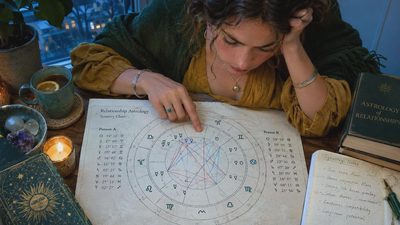
Use this sequence when reviewing a chart:
- Confirm the birth date, time, and location before interpreting anything.
- Write down the sun, moon, and rising signs without attaching a dramatic prediction.
- Add Mercury, Venus, and Mars to understand communication, relationships, and action.
- Check the houses containing those planets and identify repeated life areas.
- Note major aspects, especially patterns involving the Sun, Moon, chart ruler, or ascendant.
- Turn each theme into a question, such as, “Do I seek stability before making a change?”
- Compare the question with real decisions, conflicts, and habits over several weeks.
This method makes zodiac sign interpretation a reflective tool. It also prevents one placement from being used to explain every preference, argument, or career choice.
Use interpretations without surrendering judgment
Astrology can be engaging, but it should not become a reason to avoid responsibility. Do not use a chart to excuse controlling behavior, diagnose a mental health condition, make medical decisions, or decide whether someone deserves safety and respect. Compatibility readings should open a conversation about needs and boundaries, not serve as a pass-or-fail test for a relationship.
Be especially careful with absolute language. “You may prefer structure” leaves room for observation; “you will always betray people” creates fear without useful evidence. Strong zodiac sign interpretation describes possibilities, names uncertainty, and invites the reader to check the pattern against lived experience.
A simple journal can make the process more concrete. Record a placement, the behavior it supposedly relates to, and one real example from your week. After a month, review what consistently matched, what did not, and what required a more nuanced explanation. That evidence-based habit is more valuable than collecting increasingly elaborate predictions.
The best reading is specific enough to prompt useful reflection and modest enough to respect free will. Start with the chart data, work through the symbols in an orderly way, and leave room for the person behind the chart to be more complicated than any label.




No notes yet — write the first one.