
Understanding zodiac signs meaning is less about memorizing personality labels and more about having a useful framework for reflection. Astrology assigns each birth date to one of 12 signs, with each sign linked to certain patterns, symbols, elements, and seasonal themes. You can use those themes to ask better questions about habits, relationships, decisions, and timing without treating a horoscope as a fixed instruction manual.
This guide is organized like a project schedule: first identify the sign, then understand its operating style, and finally compare it with the rest of the chart. If it's not on the schedule, it's not happening; the same principle applies here. A broad sun-sign description is only the starting point.
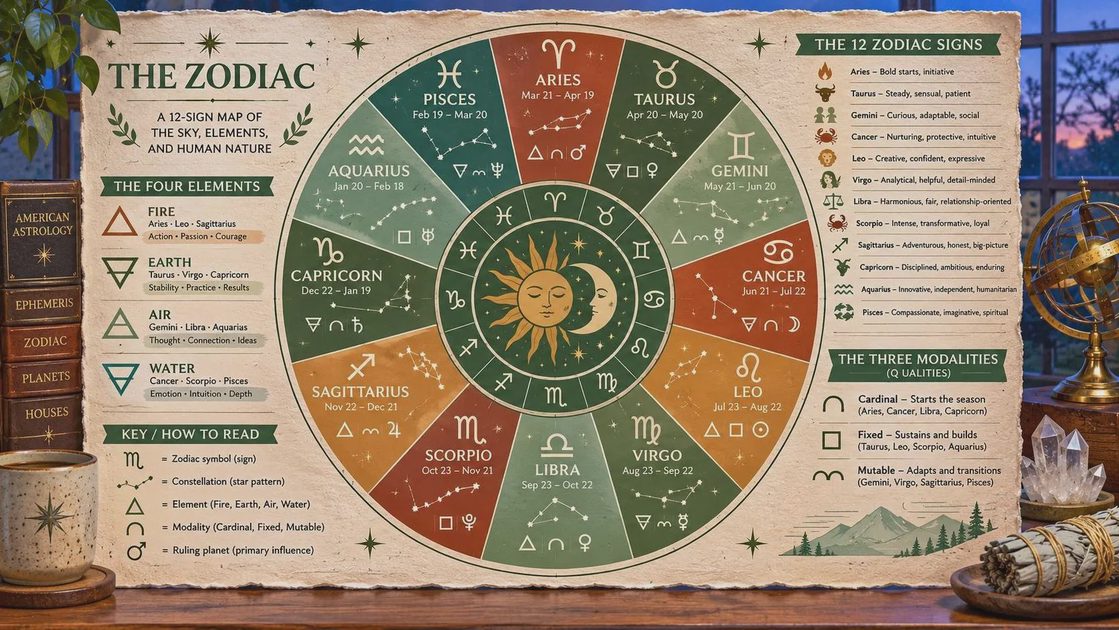
Zodiac signs meaning and the 12 sun signs
The sun sign is the sign most people mean when they ask, “What is my zodiac sign?” It is based on the sun's apparent position on your birth date. The zodiac signs meaning for each sign can be summarized as a set of tendencies rather than a guarantee of behavior.
Aries is associated with initiative, directness, competition, and fast starts. Taurus emphasizes stability, patience, comfort, and practical value. Gemini is linked with curiosity, conversation, flexibility, and information gathering. Cancer is commonly associated with protection, memory, home, and emotional sensitivity.
Leo represents self-expression, warmth, confidence, and creative leadership. Virgo is connected with analysis, service, systems, and attention to detail. Libra focuses on balance, cooperation, aesthetics, and negotiation. Scorpio is often described through intensity, privacy, persistence, and transformation.
Sagittarius points toward exploration, learning, candor, and broader perspective. Capricorn emphasizes structure, responsibility, long-term planning, and measurable progress. Aquarius is linked with independence, unconventional thinking, community, and reform. Pisces is associated with imagination, empathy, intuition, and porous emotional boundaries.
These descriptions are useful as an index, not a final inspection report. A person with a Virgo sun may not act organized in every situation, just as an Aries may carefully plan a major decision. Context, experience, and the rest of the birth chart change how a sign appears.

The four elements make the first major distinction
A practical way to understand zodiac signs meaning is to group the signs by element. Fire signs are Aries, Leo, and Sagittarius. They are usually discussed in terms of action, enthusiasm, visibility, and momentum. When a fire pattern is working well, it can get a stalled project moving. When unmanaged, it can create rushed decisions or unfinished commitments.
Earth signs are Taurus, Virgo, and Capricorn. Their themes include resources, reliability, physical reality, and repeatable systems. Earth energy is useful when a person needs to compare costs, build a schedule, or finish a task that has become boring. Its weak point can be excessive caution or resistance to change.
Air signs are Gemini, Libra, and Aquarius. They deal with ideas, language, social exchange, and perspective. Air can identify options that others miss, but too much analysis can delay a decision. Water signs are Cancer, Scorpio, and Pisces. Their themes include feeling, memory, instinct, and emotional connection. Water adds sensitivity and depth, although unclear boundaries can make a simple issue harder to manage.
The element does not tell you whether a person is good or difficult. It describes the kind of energy a sign tends to use first: action, practicality, thought, or feeling.
Modalities explain how a sign handles change
The three modalities add another layer to zodiac signs meaning. Cardinal signs begin things: Aries, Cancer, Libra, and Capricorn often represent initiation, direction, and the first move. They are useful at opening a conversation or creating a plan, but they can lose interest after the launch.
Fixed signs are Taurus, Leo, Scorpio, and Aquarius. They are associated with persistence, loyalty, concentration, and maintaining a position. Fixed energy can keep a renovation, relationship, or personal goal on track after the excitement fades. It can also make a person slow to accept new information.
Mutable signs are Gemini, Virgo, Sagittarius, and Pisces. They adjust, interpret, revise, and respond to changing conditions. This flexibility helps when a delivery is late or a plan needs a new route. The risk is scattered attention or too many revisions without a completed result.
Think of modalities as work roles. Cardinal energy starts the job, fixed energy keeps the structure steady, and mutable energy adapts the plan when reality changes. Every chart contains all three, even if one style feels more familiar.
Sun, moon, and rising signs are different assignments
The sun sign describes a central sense of identity and purpose. The moon sign is commonly used to discuss emotional responses, comfort, memory, and private needs. The rising sign, also called the ascendant, is the sign that was rising on the eastern horizon at birth. Astrologers often connect it with first impressions, outward style, and the way someone approaches unfamiliar situations.
This is why a person may not recognize a simple sun-sign description. Someone with a Capricorn sun and Gemini moon could value long-term structure while processing feelings through conversation and changing ideas. A Pisces sun with a Virgo rising might combine imagination with a careful, observant presentation.
To calculate the moon and rising signs accurately, you generally need the birth date, location, and exact birth time. A birth time rounded by several hours can change the rising sign, so do not treat an online result as precise when the underlying information is uncertain.
How to use zodiac signs meaning without overcomplicating it
Start with one real question instead of reading every possible interpretation. For example, ask why you delay a decision, what kind of support helps you recover, or how you behave when a plan changes. Read the sun, moon, and rising descriptions, then write down the parts that match repeated behavior rather than a single memorable day.
Next, compare the element and modality. A fire-cardinal combination may prefer a quick launch, while an earth-fixed combination may need proof, budget numbers, and a stable timeline. Neither approach is automatically better. The useful question is whether the approach fits the task in front of you.
Finally, test the interpretation against evidence. Did the description help you notice a pattern? Did it suggest a conversation or a practical adjustment? If not, set it aside. Astrology can provide language for self-observation, but it should not replace medical care, financial advice, legal guidance, or direct communication.
A simple birth-chart review process
Set aside 20 to 30 minutes and gather your birth date, birth location, and birth time if available. Record the sun, moon, and rising signs. Then note each sign's element and modality. Write one behavior you recognize and one behavior you want to examine for each placement.
After that, choose one small experiment. A cardinal sign theme might suggest starting a task with a 15-minute action. An earth theme might suggest making a cost list. An air theme might suggest discussing two alternatives with another person. A water theme might suggest naming the feeling behind a reaction before responding.
Review the result after a week. This turns zodiac signs meaning from a vague personality label into a structured reflection exercise. The point is not to prove that every symbol predicts an outcome. The point is to create a repeatable way to notice patterns, make choices, and adjust your process.
What sign, element, or modality best describes how you manage a delayed plan, and where does that description fail to match your real behavior?



No notes yet — write the first one.