
Let me tell you about the worst gift I ever received.
Not the worst in quality. It was beautiful. A leather journal, hand-bound, with thick, cream-colored paper that smelled like vanilla and old books. My husband Eli gave it to me for my thirty-third birthday. He'd found it at a craft fair in the River Arts District, from a bookbinder who'd been doing it for forty years. It was expensive. It was thoughtful. It was exactly the kind of thing I would have bought for myself.
I opened it. I said thank you. I put it on my desk.
And I didn't touch it for six months.
Not because I didn't like it. I loved it. I loved the weight of it in my hands, the way the pages felt, the promise of all the things I could write in it.
But I couldn't write in it. Every time I picked up a pen, I froze. The paper was too perfect. The binding was too beautiful. Whatever I wrote in it would have to be worthy of the journal itself — and nothing I could think of felt worthy.
So it sat on my desk. Empty. For six months.
Eli didn't say anything, but I could see it in his eyes. He'd given me something beautiful, and I'd put it away like it didn't matter.
And I didn't know how to explain that it mattered too much.
What The Tower Reversed Actually Means
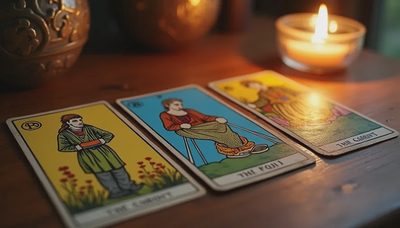
In tarot, The Tower is one of the most feared cards. It shows a tower being struck by lightning, people falling, everything collapsing. It's the card of sudden upheaval — the thing you didn't see coming, the disaster that changes everything.
But The Tower reversed is different.
It's not a disaster you didn't see coming. It's the disaster you've been expecting — the one you've been waiting for, the one you've been bracing against, the one that's been building for so long that the anticipation is worse than the actual event.
The Tower reversed says:
You've been holding on too tight
You're afraid of something that hasn't happened yet
The collapse you're dreading might not be coming
Or it might be coming — but you've already survived it in your mind a thousand times
The real problem isn't the external event. It's the internal fear.
In a gift reading, The Tower reversed tells me something specific:
The gift isn't the problem. The problem is what the gift represents — and what you're afraid it means.
What Was Really Going On With the Journal
I had to sit with that journal for months before I understood why I couldn't write in it.
It wasn't about the journal. It was about what the journal meant.
Eli had given me something beautiful and expensive and thoughtful. He'd seen me. He'd paid attention. He'd gone out of his way to find something that matched who I was.
And I was terrified.
Not of the journal. Of what it meant about us. Of what it meant about me.
If I wrote in that journal — if I filled it with my thoughts, my fears, my messy, unfinished, imperfect self — and Eli ever read it, he might see who I really was. The parts of me I didn't show anyone. The parts I was still ashamed of. The parts that didn't match the person he thought he'd married.
And if he saw those parts, he might leave.
So the journal sat on my desk. Empty. Because I was protecting myself from a future that might never come.
When the Gift Hits a Nerve
This is what I've seen in my therapy room more times than I can count.
Someone gives a gift. It's a good gift. It's thoughtful, it's meaningful, it's exactly what the person needs.
And the person freezes. Or deflects. Or puts it away and never uses it. Or says "thank you" and then changes the subject.
And the giver feels rejected. Hurt. Confused. "What did I do wrong?"
Here's what I want to tell the giver: you probably didn't do anything wrong.
But the gift hit a nerve. A nerve that was already there, long before you wrapped it.
A beautiful journal can hit a nerve if someone is afraid of being seen.
The person who's always been told they're "too much" or "not enough." The person who's never felt safe being themselves. The person who's learned that vulnerability is dangerous, that showing your true self is a risk they can't afford to take.
When you give them something that asks them to be themselves — a journal, a creative tool, a gift that says "I want to know the real you" — they freeze. Because they don't know how to be seen without feeling exposed.
An intimate gift can hit a nerve if someone is afraid of being known.
The person who's built their life around being the strong one, the capable one, the one who doesn't need anything. When you give them something that says "I see you, all of you, including the part you hide" — they retreat. Because being known feels like losing control.
A thoughtful gift can hit a nerve if someone doesn't believe they deserve it.
The person who's internalized that they're not worth the effort. When you give them something that says "you matter enough to me that I spent time on this" — they deflect. Because accepting the gift means accepting that they're worthy of it. And they haven't learned that yet.
What I Did With the Journal
I want to tell you what happened with that journal, because it's not the story I expected.
Six months after Eli gave it to me, I was still staring at it. It was still empty. It was still on my desk. And I still couldn't write in it.
One night, Eli came into my office. He sat down. He looked at the journal on my desk.
"I know you don't use it," he said. "And I want you to know: it's okay. It's not a test. I don't need you to write anything. I just thought you'd like it. If you don't, we can return it or give it away or whatever you need."
He didn't sound hurt. He sounded gentle. He was giving me permission to not use the gift.
And something clicked.
The problem wasn't the journal. The problem was my fear of using it. My fear of being seen. My fear that whatever I wrote wouldn't be worthy of the journal's beauty.
But the journal wasn't asking me to be worthy. It was just asking me to write.
So the next morning, I opened it. I wrote one sentence:
"I'm afraid this won't be good enough."
That was it. That was the first entry. A confession of fear.
And then I wrote another sentence. And another.
I filled that journal in six months. And I still have it. It's full of rough drafts and half-thoughts and things I never showed anyone. But it's full.
The gift wasn't the problem. The problem was my fear that I wasn't enough to receive it.
What I Learned About Gifts That Land Wrong
Here's what that journal taught me.
Sometimes a gift lands wrong not because it's wrong, but because the person receiving it isn't ready to accept what it's offering.
Not because they're ungrateful. Because they're scared.
Scared to be seen. Scared to be known. Scared to be loved in the way the gift is asking them to be loved.
And if you're the giver, you can't fix that. You can't make someone ready. You can't force them to accept love they're not ready to receive.
But you can do two things:
1. You can give them permission to not use the gift.
I don't mean say "if you don't like it, I can return it" in a tone that implies disappointment. I mean genuinely, freely, without expectation.
"You don't have to use this. You don't have to like it. It's yours to do whatever you want with. I won't be hurt if you give it away."
That kind of permission removes the pressure. It says: "This gift is for you, not for me. If it doesn't work for you, that's okay. I still love you."
And sometimes, that's exactly what the person needs to hear — not to use the gift, but to know they're safe.
2. You can give them time.
Some gifts aren't ready to be received on the day they're given. They need to sit. They need to wait. The person needs to grow into them.
That journal sat on my desk for six months before I was ready to use it. If Eli had asked me every week "have you written anything yet?" I would have frozen harder. But he didn't. He waited. He gave me time.
And eventually, I was ready.
A Tarot Exercise for You

If you've given a gift that landed wrong — or if you've received a gift that you couldn't accept — I want you to try something.
If you're the giver:
Pull a card and ask: "What is this person afraid of?"
Not "what did I do wrong?" Not "what should I have given instead?" Just: what are they afraid of?
The answer might surprise you. It might not have anything to do with you. It might be about control, or worthiness, or the fear of being seen.
If you're the receiver:
Pull a card and ask: "Why can't I accept this?"
Again, not "why is this the wrong gift?" Just: what am I afraid would happen if I let myself receive it?
The answer might be: "I'd have to admit I'm worth it." Or: "I'd have to be seen." Or: "I'd have to let someone in."
Those are the things The Tower reversed is trying to tell you.
What I Keep on My Desk Now
That journal is still there. It's full now. The binding is cracked in places from being opened and closed so many times. There are tea stains on the cover.
It's not perfect anymore. But it's used.
And that's what I learned: a gift that's used is a gift that's been allowed to be imperfect. A gift that's been allowed to be lived with. A gift that's been allowed to be part of someone's messy, incomplete, beautiful life.
That's what Eli gave me. Not a perfect journal.
Permission to be imperfect in it.

No notes yet — write the first one.